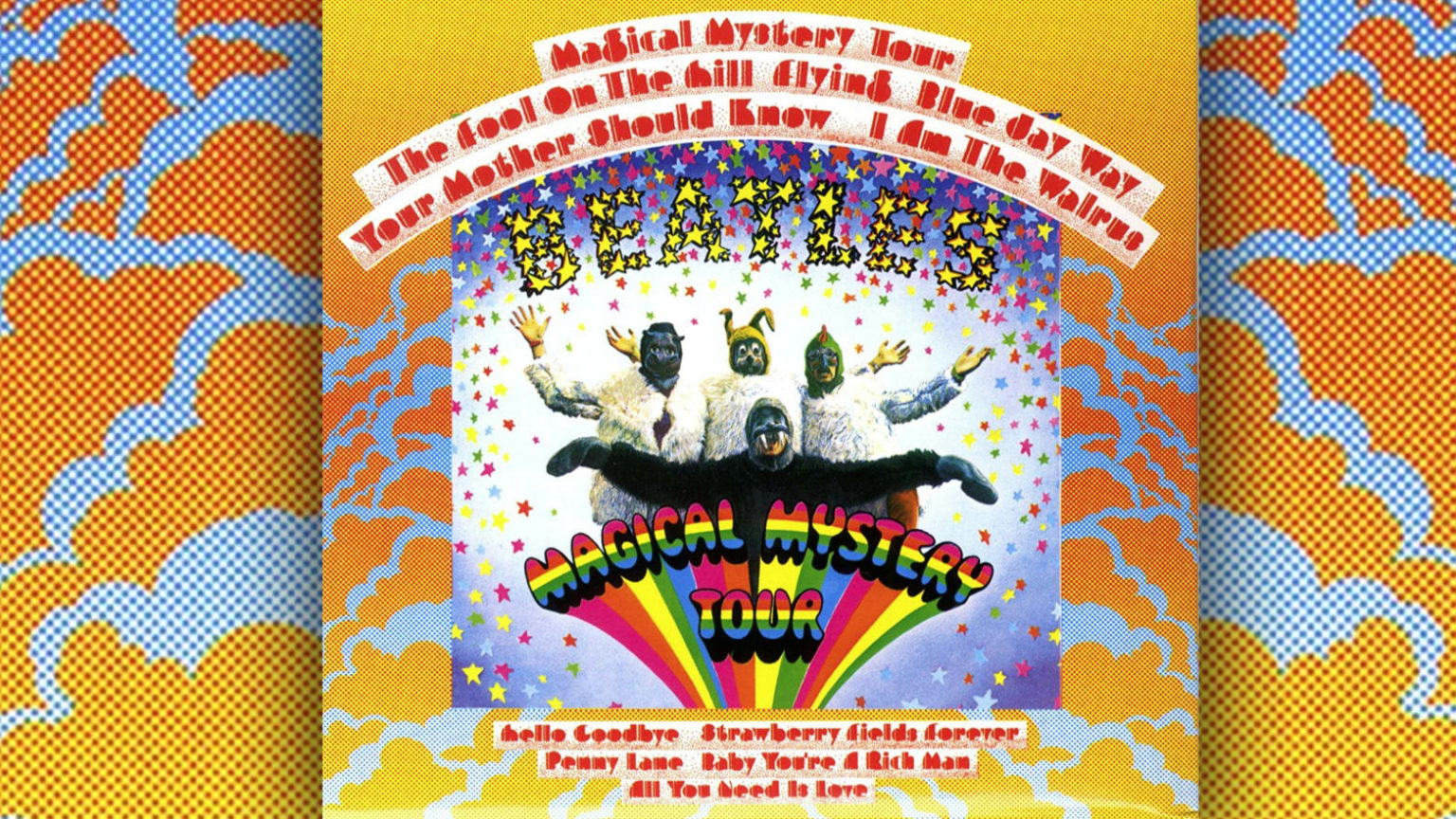
Let’s be real for a second. In 1967, everyone was obsessed with Sgt. Pepper’s Lonely Hearts Club Band. It was the "cultural moment." But if you actually sit down and listen to the songs on Magical Mystery Tour, there is a very strong argument that this collection—originally a messy double EP in the UK and a full LP in the US—is actually the superior musical achievement. It’s weirder. It’s darker. Honestly, it’s just more interesting.
While Sgt. Pepper had the concept and the uniforms, Magical Mystery Tour had the pure, unadulterated peak of the Beatles' psychedelic era. This wasn't just a soundtrack for a fairly disastrous BBC television film. It was the sound of a band losing their mentor, Brian Epstein, and trying to find their way through a haze of transcendental meditation and high-end studio experimentation.
The Chaos Behind the Tracklist
You have to understand the context. Brian Epstein died in August 1967. The Beatles were suddenly rudderless. Paul McCartney, ever the "workhorse" of the group, decided they needed a project. That project was a bus trip. It was supposed to be improvised, chaotic, and whimsical. The movie was, by most accounts, a bit of a train wreck. But the music? The music was untouchable.
In the UK, the songs on Magical Mystery Tour were released as a six-track double EP. It was a weird format. Americans, however, got a full LP because Capitol Records decided to slap the band's 1967 singles on the B-side. This turned a soundtrack into a powerhouse. You’re talking about "Strawberry Fields Forever" and "Penny Lane" sitting on the same piece of wax as "I Am the Walrus." That’s almost unfair to every other band working at the time.
Why "I Am the Walrus" is the Weirdest Masterpiece in Pop
If we are talking about the songs on Magical Mystery Tour, we have to start with the walrus. John Lennon wrote this specifically to mess with people. He had heard that a teacher at his old school was having students analyze Beatles lyrics. Lennon thought that was hilarious and ridiculous. So, he decided to write the most nonsensical, "un-analyzable" song possible.
"Elementary penguin schooling Coca-Cola!"
It’s gibberish. But it’s brilliant gibberish. George Martin’s arrangement for this track is nothing short of terrifying. He used the Mike Sammes Singers to provide those rhythmic chants ("Oompah, oompah, stick it up your jumper!") and live radio feeds that were fed into the mix. If you listen closely to the original mono mix, you can hear a BBC broadcast of Shakespeare's King Lear bleeding through the static at the end. It wasn't planned. They just turned on the radio and recorded what happened. That’s the kind of happy accident that defined this era.
The Contrast of "The Fool on the Hill" and "Your Mother Should Know"
Paul McCartney was leaning heavily into his "storyteller" persona here. "The Fool on the Hill" is a gorgeous, lonely ballad. It captures that feeling of being misunderstood, which, let’s face it, the Beatles were feeling quite a bit as they transitioned from mop-tops to mystics. Paul’s use of recorders gives it this airy, slightly medieval vibe that felt totally fresh in '67.
Then you have "Your Mother Should Know."
People love to hate on Paul’s "granny music," but honestly, this track is an earworm. It was written as a tribute to the music hall style of his father’s generation. It’s simple. It’s repetitive. It’s also incredibly well-produced. The vocal layering is lush. In the film, this is the big finale where they descend a giant staircase in white tuxedos. It’s campy, sure, but it shows the range. The Beatles could go from the avant-garde nightmare of "Walrus" to a vaudeville shuffle in five minutes.
Blue Jay Way: George Harrison’s Foggy Nightmare
George Harrison was kind of hitting his stride as a songwriter, even if he was still playing third fiddle to John and Paul. "Blue Jay Way" is often overlooked when people discuss the songs on Magical Mystery Tour, but it’s the most "psychedelic" thing on the record.
George wrote it while waiting for his publicist, Derek Taylor, in a rented house on Blue Jay Way in the Hollywood Hills. It was foggy. Derek was late. George was jet-lagged and playing a Hammond organ. The result is a swirling, droning, disorienting track. The phasing effects on the drums and the backing vocals make you feel like you’re actually lost in that Los Angeles fog. It’s moody. It’s slightly paranoid. It’s a perfect snapshot of Harrison’s headspace at the time.
The Singles That Saved the Album
We can't ignore the B-side of the US version. Even though they weren't written for the film, they are now inextricably linked to this era.
- Strawberry Fields Forever: This is arguably the greatest pop song ever recorded. It took 55 hours of studio time. It’s two different versions in two different keys and speeds spliced together. You can actually hear the "edit" at about 60 seconds in. It’s seamless, yet jarring.
- Penny Lane: The upbeat counterpoint. Paul’s nostalgia for Liverpool. The piccolo trumpet solo was inspired by a performance of Bach’s second Brandenburg Concerto that Paul saw on TV. He called the player, David Mason, into the studio the next day.
- Hello, Goodbye: A simple song about dualities. John hated it. He thought it was "Muzak." But it went to number one.
- All You Need Is Love: The anthem of the "Summer of Love." It was performed live on the Our World satellite broadcast to an audience of 400 million.
The Instrumental Mystery: "Flying"
Did you know the Beatles actually have a song credited to all four members? It’s "Flying." Originally titled "Aerial Tour Instrumental," it’s a simple, trippy loop. There are no lyrics, just some "la-la-la" vocals from the guys. It’s the only instrumental track on any Beatles studio album. It’s not a masterpiece, but it serves as the perfect "glue" for the songs on Magical Mystery Tour. It gives you a moment to breathe between the heavy hitters.
Why History Was Wrong About This Album
For a long time, Magical Mystery Tour was treated like a "minor" Beatles release because it wasn't a "proper" UK album. It was a collection of bits and pieces. But looking back from 2026, we can see it for what it is: a sprawling, experimental, and incredibly brave piece of art.
They weren't trying to be "The Beatles" anymore. They were just being themselves. They were grieving, they were tripping, and they were trying to figure out what comes after you've already conquered the world.
The movie might have been a flop—the first time the British press really turned on them—but the music has outlasted the criticism. While Sgt. Pepper feels like a museum piece sometimes, the songs on Magical Mystery Tour feel alive. They feel risky.
Actionable Insights for the Modern Listener
If you want to truly appreciate the depth of these recordings, don't just stream them on low-quality earbuds. This is an album that demands your full attention.
- Listen to the Mono Mixes: The Beatles (especially John and George) spent way more time on the mono mixes than the stereo ones. "I Am the Walrus" in mono is a completely different, much punchier experience.
- Watch the Restored Film: Don't expect a plot. Watch it as a series of music videos. The "Strawberry Fields" and "I Am the Walrus" segments are pioneering pieces of film-making.
- Track the Evolution: Listen to the Anthology versions or the Sgt. Pepper Deluxe outtakes. You can hear "Strawberry Fields Forever" evolve from a gentle acoustic demo into the mellotron-heavy beast it became.
- Analyze the Lyrics as Poetry: Despite Lennon’s claims that "Walrus" was nonsense, the wordplay is incredible. He was heavily influenced by Lewis Carroll and the "Jabberwocky" style of linguistics.
The songs on Magical Mystery Tour represent the moment the Beatles stopped being a boy band and became a laboratory. They broke the rules because they didn't even know the rules existed anymore. Whether it’s the soaring brass of "All You Need Is Love" or the unsettling drone of "Blue Jay Way," this collection is the definitive document of 1967. It’s messy. It’s brilliant. It’s essential.